Twin Home Birth After Being Told She Had "No Pain Tolerance"
Oct 05, 2026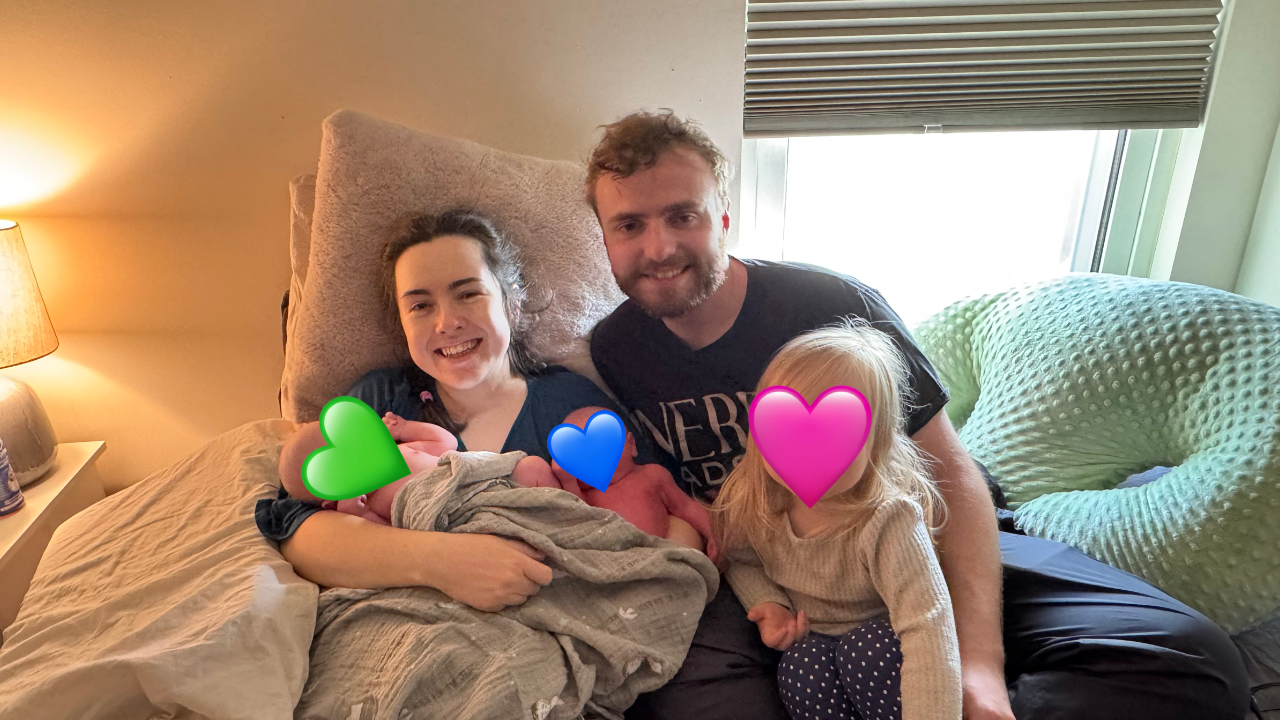
Can you give birth to twins at home? Emily Lewenczuk was told no — by her whole city, essentially. She had done the research herself, for a client, only weeks before she took her own positive pregnancy test. In St. Louis, nobody was taking twins at home.
She had them at home anyway. Here's how that happened.
She was a doula before she was a mother
Emily found birth work sideways. In college she worked for a nonprofit supporting women in crisis pregnancies, and she noticed something that didn't sit right: these mothers had help with rent and help with medical bills, and not one person beside them in labor. As she puts it, a woman going into labor without knowing anyone in the room is not a small thing. That gap pulled her in. Then she read Ina May Gaskin, and, in her words, that was the beginning of the end for her.
Before she was even married, she told a family member she thought she might want a homebirth someday. The answer she got back: you're very sensitive, you have a terrible pain tolerance, you'll need that epidural, you can't do it.
Emily's response, mostly in her own head: challenge accepted.
The first birth: Christmas Eve, gestational diabetes, and a transfer
Emily's first pregnancy came with a gestational diabetes diagnosis she managed through diet — which meant she got to stay home. Her daughter arrived ten days after her due date, on Christmas Eve, with the decorations still up. Labor was around ten hours. Emily pushed on her back, which she says now she'd been picturing all along even though she knew it wasn't the friendliest position for her perineum. She tore, more than her midwife was willing to repair at home, and the family transferred to the hospital afterward. Her daughter came with them. Nobody was separated.
She'll tell you it was a good experience. She'll also tell you exactly which part of it she'd do differently. Both are true.
Two positive tests and a joke that came true
Between babies, Emily overhauled her diet onto an anti-inflammatory protocol. She thinks that's the reason the twin pregnancy went the way it did: no gestational diabetes the second time, stable blood pressure, stable blood sugar, in a pregnancy where everyone had expected the opposite.
She took a pregnancy test the morning after weaning her daughter, mostly certain it would be negative. It wasn't. Neither was the second one. And looking at those two positive tests she had a passing thought — wouldn't it be funny if it was twins?
At eight weeks, her midwife went quiet during the ultrasound. Here's baby. Here's a yolk sac. But I think I see— that's another baby.
Her husband started pacing. Emily looked at her midwife and said: you don't take twins, do you?
She didn't. But she had the names of two midwives in the area who did — two options that had been sitting there all along, missed because two months earlier Emily had asked "do you take twins?", heard no, and stopped asking. She interviewed both of the new midwives within a week. Both of them ended up at her birth.
MoDi twins, and a pregnancy that got watched closely
At a maternal ER visit around nine weeks for a bleeding scare, Emily learned her boys were MoDi — monochorionic diamniotic. Her own explanation is the best one you'll hear: Di-Di twins get their own room, their own apartment, and their own vending machines. MoDi twins have their own sacs but share a placenta. MoMo twins share everything.
Sharing a placenta means monitoring for twin-to-twin transfusion syndrome, so Emily was scanned every other week starting at sixteen weeks, in co-care with a hospital MFM team she liked and appreciated, even knowing they didn't understand why she wanted to be home. When something concerning showed up — a blood vessel sitting too close to her cervix — she came back two weeks later and it had shifted as the babies grew.
Two other things worth naming. Emily made her peace with a cesarean early and put it in her back pocket, so it stopped being a threat. And she was careful about what she read: the twin-mom Facebook groups are full of hard stories, and she watched women get taken apart in the comments for mentioning a homebirth plan. She stayed mostly quiet online and told everyone in her actual life.
"That is the floor. That's not the ceiling."
At thirty-eight weeks her MFM was ready to induce that day. A fellow asked her, honestly curious, why she wanted them at home so badly. Emily told him she knew the staff there was excellent — and that she'd built the dream team.
Then she asked her own question: if you induced me, what method?
Pitocin, they said, and break your water.
Baby A had a velamentous cord insertion — his cord's blood vessels ran unprotected through the membranes instead of into the placenta. Her midwife had already told her she'd never break Emily's water, because she'd be going in blind. So Emily looked at the plan and said what nobody in the room had said yet: so you're potentially going to cause the problem that you are very worried about.
That's when the doctor came back to healthy mom, healthy baby. And Emily agreed with him, and then went further: that's the floor. That's not the ceiling.
The one day her midwife couldn't be there
Emily's midwife had been clear from the start. She'd be available around the due date except for one single day: November 13th, her sister's wedding, 10am to 10pm.
Emily labored on November 13th.
At 5:30 in the morning, alone with her almost-three-year-old while her husband was at a workout with his phone in the car, Emily got up and passed a large clot. Her biggest fear, named out loud to her mother weeks earlier, was labor starting while she was home alone with her daughter.
She called her midwife anyway. The response: send me a picture. That looks like bloody show. I think you're fine. I'm going to get a shower and then head over to you. Emily notes, dryly, that this is not the phone call you get from a hospital.
Her mom turned her car around on the way to the gym. Her doula called her husband on repeat until he saw the missed calls. Her house filled: three midwives, a student midwife, a doula, her mom, her husband, and a not-quite-three-year-old. Emily calls it an actual birthday party.
Baby A had been sunny side up at the scan the day before, so she labored on all fours to encourage him around. Her one and only cervical check came when her midwife arrived — a four on one side, a five or six on the other, which is what happens while a baby is turning. He was, as Emily puts it, doing exactly what he needed to do.
She got up off the toilet because she was not about to have a toilet baby, walked out to a room full of people inflating a birth pool she would never get into, and announced that this baby was coming fast. He came in about four pushes, and he came in the caul — his head, at least. Emily's own theory, offered as a mother and not a clinician, is that the intact bag was protecting that exposed vessel the whole way down.
The longest hour
Twins are usually born close together. Emily's boys were an hour apart.
She went from praying out loud — what the Lord has started in me, He is going to finish — to expletives she doesn't normally use, to what she describes as cavewoman sounds. Her daughter got scared. A midwife knelt down and told the little girl that this is how babies are brought into the world, and that her mommy was strong. And Emily, mid-labor, mothered her: I'm not afraid. You don't have to be afraid. We can do hard things.
A while later her daughter asked if she could sing to her baby brother. She sang Jesus Loves Me, the song she'd sung to Emily's belly every night of the pregnancy, and every midwife in the room joined in. Emily had forgotten it entirely until she read back through her notes.
Baby B was born. The placenta took longer than she wanted. And Emily bled more than she should have.
She'd read the research on inter-twin intervals, so she knew what an hour meant. She'd also already talked through her options with her midwife. They started with tinctures. Nobody in the room used the word hemorrhage, because Emily already knew what was happening and the team stayed calm. It resolved. And afterward, she genuinely forgot it had been part of the story until her doula reminded her she'd been an active participant in the conversation.
That's not a story about a complication not being serious. It's a story about not being blindsided by one.
Then she held both of her babies in her own bed. There's a video somewhere of her saying, I want both, give me both.
What she'd tell a twin mom
Emily is careful here, and I appreciate her for it. There are hard outcomes in twin pregnancies. She's not interested in pretending otherwise, and she's genuinely grateful for the NICUs and the doctors in her city. Two things can be true: there are bad outcomes, and there are good ones.
What she'd say is this — ask good questions, and don't let someone else's story or opinion become your prescription. Ask for opinions from the people who have the results you're actually after. Get multiple perspectives.
And then decide. It's your call.
Listen links: Apple Podcast · Spotify Link · [YOUTUBE LINK]
FAQ
Can you give birth to twins at home?
Some women do, though it remains uncommon and ACOG lists twin birth at home as contraindicated. In the largest published study of community twin birth — Fischbein and Freeze's 2024 PLOS ONE review of 100 twin pregnancies — 91.3% of the women still in the practitioner's care at the onset of labor gave birth vaginally, with an 8.7% in-labor cesarean rate. Availability depends heavily on state law and on finding a provider skilled in twin and breech birth.
Do twins have to be born by cesarean?
No. ACOG Practice Bulletin 231 states that for diamniotic twins at 32 0/7 weeks or later with a vertex presenting twin, vaginal birth is a reasonable option regardless of the second twin's presentation, provided a clinician experienced in internal podalic version and vaginal breech delivery is available. The 2013 Twin Birth Study (NEJM) found no benefit to planned cesarean for cephalic-first twins. In practice, the U.S. twin cesarean rate was 74.8% as of 2013 — a gap driven largely by the loss of breech skills rather than by evidence.
What are MoDi twins, and what is TTTS?
MoDi is shorthand for monochorionic diamniotic — twins who share one placenta but have separate amniotic sacs. Because they share placental circulation, they can develop twin-to-twin transfusion syndrome, in which blood flows unevenly between them. TTTS occurs in roughly 10 to 15% of monochorionic pregnancies and usually develops between 16 and 26 weeks, which is why MoDi pregnancies are typically scanned every two weeks through the second trimester.
What is a velamentous cord insertion?
A velamentous cord insertion is when the umbilical cord's blood vessels insert into the membranes rather than directly into the placenta, leaving a stretch of vessel without the protective Wharton's jelly around it. It occurs in roughly 1.5% of singleton pregnancies and about 6% of twin pregnancies. Most are found after birth and cause no problem; the main concern is compression or rupture, particularly if the membranes are broken artificially over the exposed vessels.
How long is it safe to wait between the birth of twin A and twin B?
There's no universal time limit, but longer intervals track with more maternal blood loss. In the Fischbein and Freeze cohort, mothers with blood loss of 1,000 ml or more had an average inter-twin interval of 62 minutes, compared with about 25 minutes for those below that threshold; the team began recommending intervention after 30 to 45 minutes if labor hadn't resumed. The same study found no significant difference in the second twin's Apgar scores by interval length. This belongs in conversation with your own provider — you get to choose your own risk tolerance and where you feel safest.
This article shares one mother's personal experience and is offered as encouragement and education, not medical advice. Twin pregnancy carries real and specific risks, and decisions about your care belong with you and a provider you trust.
Sources: Fischbein SJ, Freeze R. Twin home birth: Outcomes of 100 sets of twins in the care of a single practitioner. PLOS ONE, 2024 · ACOG Practice Bulletin No. 231, Multifetal Gestations, 2021 · Barrett JFR et al., A Randomized Trial of Planned Cesarean or Vaginal Delivery for Twin Pregnancy, NEJM 2013 · Ebbing C et al., Prevalence, risk factors and outcomes of velamentous and marginal cord insertions, PLOS ONE 2013
Lorem ipsum dolor sit amet, consectetur adipiscing elit. Cras sed sapien quam. Sed dapibus est id enim facilisis, at posuere turpis adipiscing. Quisque sit amet dui dui.
Stay connected with news and updates!
Join our mailing list to receive the latest news and updates from our team.
Don't worry, your information will not be shared.
We hate SPAM. We will never sell your information, for any reason.