Six Births, No Two Alike: What Rebecca Menning Learned About Trusting Her Body
Aug 31, 2026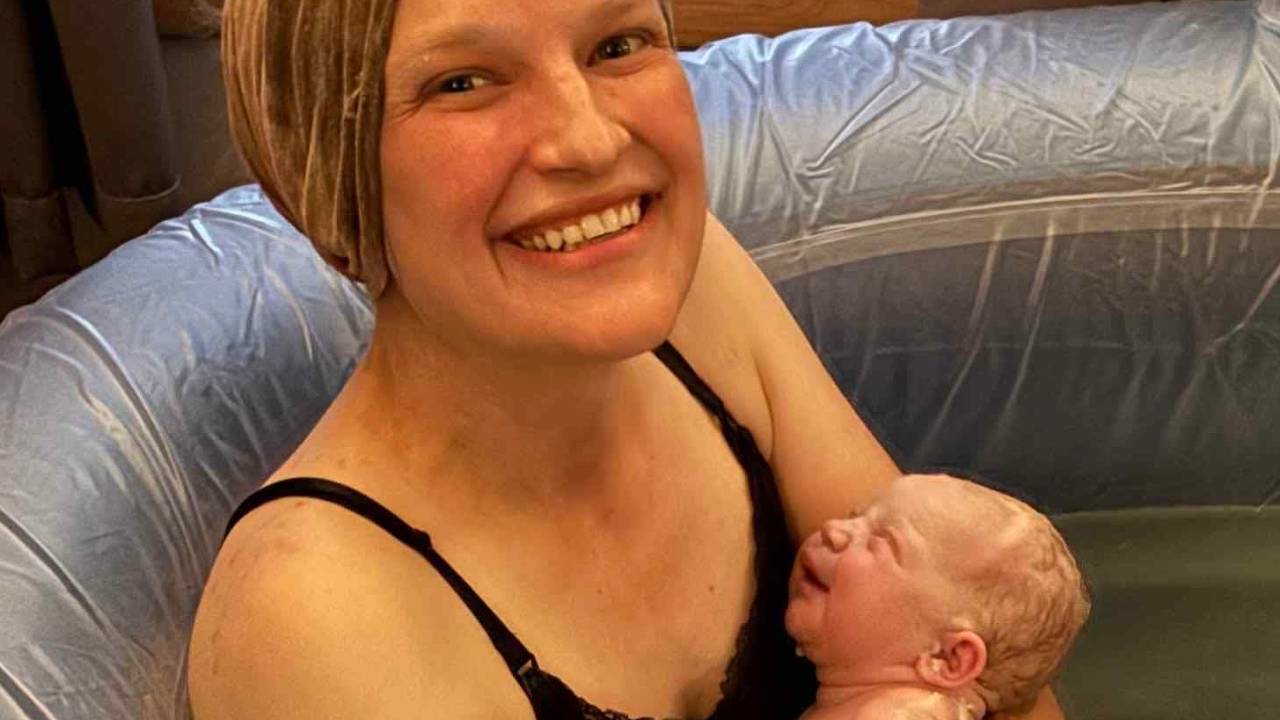
Some birth stories hand you a formula. Rebecca Menning's hands you something better– permission to let the formula go.
Rebecca has given birth six times, and not one of those births looked the same. Her labors have run from three and a half hours to thirty-eight. Her babies have weighed from eight pounds to over ten. She's gone into labor at thirty-nine weeks and at forty-two. She's transferred to the hospital, and she's caught her own baby at home in the water. If you've been looking for the pattern– the reassuring "this is just how my body does birth"– Rebecca is living proof that the range of normal is so much wider than most of us are told. And in this episode of the Happy Homebirth Podcast, she'll show you why that's a gift and not a threat.
How much can a normal birth actually vary?
A normal, healthy birth varies enormously– in timing, length, and baby's size. Full-term birth spans roughly 37 to 42 weeks, healthy newborns commonly range from about 6 to 10 pounds, and labor can last anywhere from a couple of hours to well over a day. Rebecca's six physiological births alone ranged from 3.5 to 38 hours and from 8 pounds to over 10– all within the range of normal.
That's the thing most of us are never told. We go looking for our "type"– I'm a fast laborer, I always go early, my babies are always small– and then we're thrown when a birth doesn't match the story we built. Rebecca's six births are a gentle argument against needing that story at all.
What is a physiological birth?
A physiological birth is labor and birth that unfold on the body's own hormonal design, without routine intervention to start, speed, or manage them. The mother's brain, uterus, and baby work together, releasing the hormones of labor in their own rhythm and time. It doesn't mean nothing ever changes course– it means the process is trusted to lead unless there's a real reason to step in.
Rebecca has lived both sides of that. Five of her births were physiological homebirths. One ended in a hospital transfer. And she'll be the first to tell you the transfer wasn't a failure– it was her body and her team making a wise call in the moment.
Rebecca's six births at a glance
|
Birth |
Gestation |
Length of labor |
Baby's size |
Setting |
|---|---|---|---|---|
|
First |
42+ weeks |
~38 hours |
9 lb 5 oz |
Hospital transfer (vacuum-assisted) after laboring at home |
|
Second |
40+ weeks |
~8 hours |
8 lb 6 oz |
Home |
|
Third |
41+ weeks |
~3.5 hours |
10 lb 5 oz |
Home (water) |
|
Fourth |
40+ weeks |
~7 hours |
8 lb 9 oz |
Home ("dreamy," three answered prayers) |
|
Fifth |
39+ weeks |
~5 hours |
8 lb 14 oz |
Home– repositioned to bring baby down |
|
Sixth |
40+ weeks |
~2.5 hours |
Healthy, pink, first with vernix |
Home (water), peaceful |
Sizes and timings are as Rebecca recounted them on the episode. Every birth is individual– this table is her story, not a prescription.
What her first birth taught her about a hospital transfer
Rebecca's first labor lasted thirty-eight hours and ended with five hours of pushing, a transfer, and a vacuum-assisted birth. She didn't want to be in the hospital. And still– she didn't come away feeling defeated. She came away thinking, I basically had a homebirth except for the very end. If I can do all of that, next time will be more than possible.
That reframe is worth pausing on if you carry a hard first birth. A transfer is not the opposite of a good birth. Rebecca's authorship of her own experience– the laboring undisturbed at home, the support around her, the decision to go when it was time– stayed intact. The measure of a birth was never whether she avoided the hospital. It was whether she moved through it as the leader of it.
Why does labor vary so much from birth to birth?
Labor varies because every pregnancy is a different baby, a different position, a different hormonal picture, and a different season of the mother's life. Baby's size and station, how the baby is positioned, whether it's a first birth or a sixth, rest, stress, and simple physiology all shape how a given labor unfolds. Even the same mother, like Rebecca, can have six labors that share almost nothing.
On the episode, Rebecca describes her third birth waking her out of a dead sleep with double-peaking contractions and no break– a "runaway horse," she called it– arriving in three and a half hours. Her fifth asked something of her she'd never tried: after an hour of pushing with no progress, she got out of the pool, changed position, felt the baby slide back and realign, and then birthed in a single push. Same body. Completely different births. What carried her wasn't a technique she repeated. It was her willingness to stay present and respond to the birth she was actually having.
Is it normal to feel afraid before a homebirth?
Yes– fear before birth is normal, and it doesn't mean you've chosen wrong or that you aren't ready. Everything we know about fear, tension, and pain in labor is still true, and it's worth doing the work to meet your fear. But fear is not a moral failing, and it is not disqualifying. You can be afraid and prepared at the same time.
This is the heart of what Rebecca offers. Before her sixth birth, walking laps around her driveway with a toddler on her hip, she stopped at the edge of a field and said out loud the thing her positive thinking had never let her say– that if the Lord wanted to take her life, or her baby's, that day, she trusted Him with it. In her words:
"There's no moral failing of being afraid… we can come to our Father and say, 'I'm afraid.' And He can carry us in that, and He will carry us in that."
What came after that honesty wasn't panic. It was peace. Hours later she found herself smiling through the contractions, whispering "birth is easy." Now, does that mean surrender guarantees you an easy, pain-free birth? No, of course not– Rebecca would be the first to say a peaceful birth isn't a reward for doing it right. But meeting her fear honestly is what let her walk into that birth with open hands.
Frequently asked questions
Is it normal to go past 42 weeks? Going past 42 weeks is less common but can fall within the range of normal for some mothers, and it's a decision point to weigh carefully with your provider. Rebecca's first baby was born at just over 42 weeks after undisturbed labor. Post-term pregnancy does carry considerations worth discussing with your midwife, so this is a conversation to have with your own care provider, not a rule.
Can a homebirth transfer still be a good birth? Yes. A transfer to the hospital does not make a birth a failure. The measure is whether the mother remained the author of her decisions, supported and informed. Rebecca transferred with her first birth and still describes it as a birth she led, not one that happened to her.
Does a long pushing stage mean something is wrong? Not necessarily. Pushing stages vary widely, and a long one can simply mean baby needs a position change to navigate the pelvis. In Rebecca's fifth birth, an hour of pushing with no progress resolved the moment she changed position and let the baby realign. Anything concerning belongs with your midwife in the moment.
How do you prepare for a birth when you can't predict it? You prepare the mother, not the outcome. Learning how birth works, practicing nervous-system regulation, meeting your fears ahead of time, and preparing your home and your spouse all hold steady no matter which birth you get. That's the whole idea behind preparing the whole woman rather than rehearsing one script.
What Rebecca's story leaves you with
Six births. No two alike. And underneath all that variation, one thread that never changed: open hands. Rebecca stopped needing birth to follow a formula, and that's exactly what freed her to meet each one with presence instead of panic. Your body doesn't owe you a pattern. Fear isn't a failing– it's just something asking to be met. And whatever your birth looks like– fast or slow, at home or transferred, easy or the hardest thing you've ever done– it can still be one of the most sacred places you're ever called into.
Listen to Rebecca's full story in episode 342 of the Happy Homebirth Podcast.
And if her story left you wondering how ready you actually are for your own birth– not where you wish you were, but where you actually stand right now– I made the Homebirth Readiness Check for exactly that. Ten questions across the seven areas of preparation, walked through with me on video, and an honest picture of where to focus next. There's no failing grade here. It's free, at myhappyhomebirth.com/ready.
About the author: Katelyn Fusco is a homebirth mother of four, doula, and student midwife, and has hosted the Happy Homebirth Podcast since 2019. This article is a birth-story reflection offered as encouragement and education, not medical advice. Anything about your body or your baby belongs with your midwife.
A note on the sources here: the term-gestation and newborn-size ranges reflect standard obstetric definitions (e.g. ACOG's classification of "term" as roughly 37–42 weeks). Medical guidance is updated over time– confirm the current figures before publishing.
Lorem ipsum dolor sit amet, consectetur adipiscing elit. Cras sed sapien quam. Sed dapibus est id enim facilisis, at posuere turpis adipiscing. Quisque sit amet dui dui.
Stay connected with news and updates!
Join our mailing list to receive the latest news and updates from our team.
Don't worry, your information will not be shared.
We hate SPAM. We will never sell your information, for any reason.