Getting Pregnant Without a Period: Sabrina's Two Homebirths and What Changed Between Them
Sep 14, 2026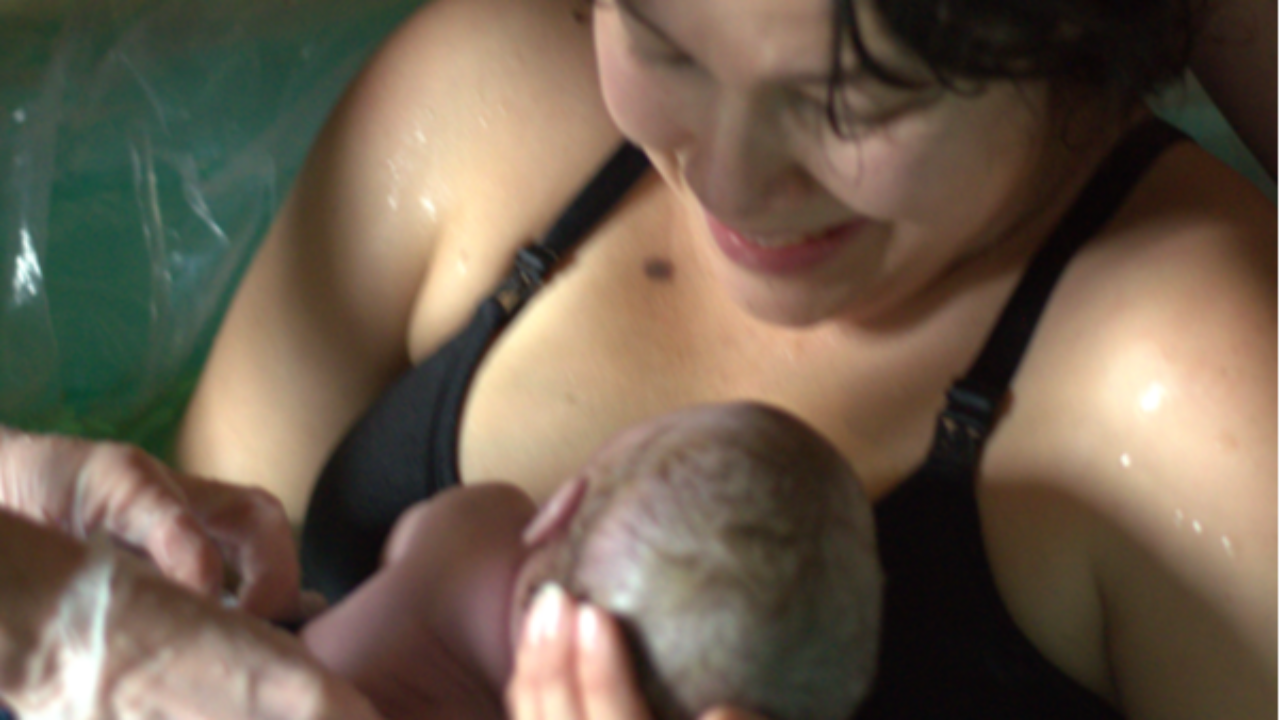
Some birth stories are about what happened. This one is about what a woman had to learn how to do.
Sabrina Brooks grew up in a family where birth simply happened at home. She was born at home. Her brother was born at home. Her aunt went on to have eight children, seven of them at home, and Sabrina was in the room for many of those births as a girl. If you've listened to episode 338 with Cynthia Cruz, you've already met Sabrina's mother — the woman who chose homebirth in California more than thirty years ago, found a lay midwife in the Yellow Pages, and went first so that everyone behind her could follow.
So homebirth was never the hard part. The hard part was her body.
A year and a half, and two periods
For most of the first two years of her marriage, Sabrina barely had a cycle. Two periods in about eighteen months. Her hair was falling out — enough that she noticed how short it had gotten without ever cutting it. She'd lost weight she didn't have to lose. And because it came on so gradually, she didn't fully register it until she looked back at older photographs and thought, I look different, and I don't understand what's going on.
Here's what makes this worth sitting with: by every standard our culture applauds, she was doing well. She was running regularly. She was eating what she understood to be a healthy diet. She was disciplined.
Then she met a friend at a pickleball game.
Teri mentioned she was pregnant with her fifth and considering a homebirth — and that her family was pushing back hard, and that she felt alone in it. Sabrina, who had spent her whole childhood watching babies be born at home, got to tell her: this is normal, and you can absolutely do this.
That single conversation is the hinge of the entire story. Teri was working with a midwife named Deb who also helped women with hormonal issues. Sabrina connected with her. Deb ran labs and found her progesterone and estrogen essentially bottomed out.
Deb's recommendation was almost anticlimactic. Given how much you're running: eat more protein, and eat more carbohydrates, in the form of fruits and vegetables.
Sabrina's reaction was the one most of us would have. There's no way it can be that simple.
It was pretty much that simple. She got her results in April, on her twenty-fifth birthday. She had a cycle again by June. She missed her period in July and conceived in August — without a period the month before, which is why she took three pregnancy tests and started googling the odds of three consecutive false positives.
And the reciprocity kept going. Teri's baby was born a few weeks later, and Sabrina — newly pregnant — was there for it, attending a homebirth with the very midwife who would go on to catch her son.
The fear that showed up at thirty-six weeks
Sabrina's first pregnancy was healthy. She ran three 5Ks in the first half of it, taught fourth grade through the exhaustion of the first trimester, and worked through a placenta previa flag at her twenty-week scan by researching it thoroughly and declining a third-trimester ultrasound she didn't feel she needed. Her midwife respected that.
Then at thirty-six weeks, a different kind of fear arrived: I don't think I know how to relax.
She's a busy person. A productive person. Sitting still and doing nothing has never been her natural mode. And she was suddenly aware that this baby was going to have to come out of her body, and that it would require a kind of letting go she had never once practiced on purpose.
Her husband Sam made her a playlist. She started listening to two songs a night — maybe six minutes — doing deep breathing before bed, with a plan to use the same playlist in labor.
Which is worth noting: six minutes a night, started at thirty-six weeks, when she was convinced she'd left it too late. She hadn't. She went to forty-two weeks.
Freeman's birth: the wall at six centimeters
Her parents flew in at thirty-eight and a half weeks, ready for a baby. The baby was not ready. Three long weeks later, with swelling setting in and no baby, they flew home on a Thursday. Sabrina went into labor Friday afternoon. She's fairly convinced her body was waiting for the house to clear.
Contractions stayed consistent through the night, with a contraction timer under her pillow and enough broken sleep to matter later. In the morning: her friend Teri, eggs, and fresh-squeezed orange juice from her parents' California orange trees. Her husband went to start the birth playlist and accidentally played "It's a Great Day to Be Alive" by Travis Tritt, which was not on the playlist, and which she now thinks of every time she hears it.
At 3 p.m. her midwife arrived and checked her at four centimeters — a number she found neither encouraging nor discouraging. Just a fact. She started the Miles Circuit, threw up, and got so cold she was shivering under a comforter. Into the tub at 5:30. Checked again at 6:40: five to six centimeters, and this time it landed hard.
The stretch from six to ten was the most excruciating part of her entire labor, and the part her memory stretched longest — though the timeline shows it was under an hour. This is where she hit the wall. She didn't say it out loud, but in her head: there's no way I can do this. And right behind it, a thought she was carrying in her own bedroom, in her own house: I'm going to be labeled failure to progress.
She started feeling pushy around 7:30. Her midwife didn't check her — she trusted what Sabrina's body was telling her. Sam got into the tub behind her, and she held onto him, leaning back in a position she'd reconsider later but couldn't move out of at the time. They brought a mirror. Freeman was born at 8:40 p.m., at forty-two weeks, after about forty-five minutes of pushing, with a friend photographing the whole thing.
He didn't breathe right away. Her midwife asked her to give him a couple of rescue breaths, and it simply didn't register — she was too deep in it. He coughed, the midwife gave him a couple of breaths, and he cried. They lifted him up to find out he was a boy.
The part that was harder than birth
Nursing was difficult from the start, and Sabrina didn't know how difficult. Freeman hardly nursed at all in the first twenty-four hours and wasn't latching well, and she didn't know how to fix it or that she should ask.
At three and a half weeks postpartum, she flew alone with her newborn to California for a wedding. It went well, by her account. It also, she suspects, cost her more than she realized.
At six weeks postpartum, she got mastitis, and she got it badly. She had read an entire book on breastfeeding. She had listened to the podcasts. She did not recognize it in her own body until it was too late for gentle measures. Two rounds of antibiotics — devastating to her after avoiding all of it through pregnancy and birth — and then a breast abscess that eventually ruptured at home. She waited until Monday, saw a doctor for a simple drainage procedure, and kept nursing.
She calls it the hardest thing she's ever gone through. Harder than his birth.
Her own summary of it is the sentence worth underlining: knowing something theoretically and recognizing it in your own body are two entirely different things, especially in the fog of new motherhood.
Whitley's birth: the same body, a different skill
Sabrina's cycle returned at twenty months while still nursing, once she put some parameters around it. It's been consistent ever since.
Her second pregnancy was straightforward. A different midwife — the assistant from her first birth, who had opened her own practice — came to Sabrina's house for most appointments. One ultrasound at twenty weeks. Gender a surprise again.
And this time she took a birth course, which she hadn't done with Freeman. One idea from it stuck: contractions have a purpose, and you breathe into them rather than bracing against them. She'd read that before. But now she'd had a birth, and it finally landed.
The lead-up was almost comic. Her sister-in-law Gigi was scheduled to fly out on the due date, her mother to fly in a week later. The baby was late. A snowstorm buried Savannah, Georgia, delaying Gigi's flight, and after a text to her brother, Gigi's return got pushed to Friday — meaning she'd be there after all. Her mother arrived Tuesday afternoon.
Labor started Wednesday morning.
Sabrina has a theory about that, and it's a good one. Her first labor started once her parents left. Her second started once her mother arrived. Both times, the variable was the same: her body wouldn't start until the question of who is taking care of my people was answered. As she put it, once her mom was there, her body seemed to decide Freeman was in good hands, and she could relax enough to have a baby.
She woke at 7 a.m. with consistent contractions and a stain in her underwear. There was meconium in the water — noticeably so once her water released more fully on the couch around one. Her midwife arrived at two and checked the baby's heart rate, which was fine. Sabrina wasn't worried, and her reason is lovely: this baby had been kicking all day, so actively that it almost seemed like the kick started the contraction. She was being told, over and over, that the baby was fine.
She got into the birth pool at 2:50. She was never checked. There's no record in her birth notes of when pushing started, because the transition from progressing to pushing was seamless.
She was loud. She was also, for the first time, able to relax her lower half — and she stayed convinced the entire way through that every contraction was bringing her closer to her baby and doing good work. Whitley was born at 3:38 p.m., green-headed from the meconium, immediately crying, perfectly healthy.
What made it redemptive wasn't the speed. It was that she never once reached the point of thinking she couldn't do it.
Postpartum was different too. Whitley latched quickly and gained fast. Sabrina had a couple of mastitis scares, ordered antibiotics as a precaution and never needed them, because this time she caught the signs early. Her midwife checked on her deliberately and often, knowing what had happened the first time.
And Gigi — who Sabrina was sure she'd frightened off by being so loud — was completely won over, and went on to have her own homebirth.
What she'd want you to take from it
Three things, in her own framing. That you have to nourish your body if you're going to support life. That experiencing something is different from reading about it, and that you need people you can run things by when your brain isn't fully online. And that learning to relax — to stop bracing against your own body — changed her birth more than anything else she did.
This article shares one mother's personal experience and is offered as encouragement and education, not medical advice. Always bring questions about your own pregnancy, birth, and postpartum to a trusted care provider.
Listen to the full episode here: Sabrina's Birth Stories
Watch the full episode here: Sabrina's Birth Stories
FAQ
Can you get pregnant without having a period first? Yes. Ovulation happens before menstruation, so it's entirely possible to conceive during the first ovulation after a stretch without cycles — before a period ever returns. That's exactly what happened to Sabrina, who had gone about eighteen months with only two cycles and conceived without a period the month before. It's also why a missing cycle doesn't necessarily mean a closed door, and why tracking fertility signs can be more informative than waiting for a period to show up.
Can not eating enough or exercising too much stop your period? It can. When the body is running a consistent energy deficit — often from a combination of high activity and inadequate intake — reproductive hormones are frequently among the first things down-regulated, since building a baby is metabolically expensive. Sabrina's labs showed her progesterone and estrogen essentially bottomed out while she was running regularly and eating what she believed was a healthy diet. Her midwife's guidance was to increase protein and add more carbohydrates from fruits and vegetables. Her cycle returned about two months later. Hormonal disruption has many possible causes, so this belongs in conversation with a trusted provider rather than treated as a formula.
Does meconium in the water mean you have to transfer to the hospital? Not automatically. Meconium in the amniotic fluid is relatively common, particularly with babies born at or past forty weeks, and midwives generally assess it in context — how thick it is, what the baby's heart rate is doing, and how labor is progressing overall. In Sabrina's second birth, meconium was clearly present, her midwife monitored the baby's heart rate, everything looked reassuring, and her daughter was born at home crying immediately. How any individual situation should be handled is a decision for a mother and her own care provider.
Why does relaxation matter so much in labor? Because tension works against the muscles that are trying to open. Grantly Dick-Read described this as the Fear–Tension–Pain cycle: fear creates physical tension, tension increases pain, and pain feeds more fear. The practical implication is that relaxation is a skill worth practicing well before labor, not summoned on the day. Sabrina's two births are a vivid illustration — she describes being tense through her first and hitting a point of thinking she couldn't continue, and being able to release her lower half through her second, which she found dramatically more manageable mentally. Relaxation practice is not a guarantee of an easier labor, but it does change what a woman has available to her when labor arrives.
What are the early signs of mastitis, and how fast does it move? Common early signs include a tender or hardened area in the breast, localized redness or warmth, and flu-like symptoms such as chills, body aches, or fever. It can escalate quickly, which is precisely why it's easy to miss in early postpartum, when a mother is already exhausted and sore. Sabrina had read a full book on breastfeeding and still didn't recognize it in herself until it had progressed too far for gentle measures, and it developed into an abscess. Her advice from the other side of it is worth taking: know the signs in advance, act at the very first suspicion of a clogged duct, and have someone experienced you can check in with. Anything happening in your own body belongs with your provider.
Lorem ipsum dolor sit amet, consectetur adipiscing elit. Cras sed sapien quam. Sed dapibus est id enim facilisis, at posuere turpis adipiscing. Quisque sit amet dui dui.
Stay connected with news and updates!
Join our mailing list to receive the latest news and updates from our team.
Don't worry, your information will not be shared.
We hate SPAM. We will never sell your information, for any reason.